Tuesday, April 26, 2011

Cuenca


(The third largest city in Ecuador.)

I'm currently in the middle of my eleven day spring break. I spent the first few days of it in Cuenca, a city towards the south of Ecuador. Cuenca is known throughout South America for its colonial architecture. In fact, Cuenca is consistently ranked as one of the top if not the top retirement haven by sources such as U.S. News & World Report and International Living.

Me in front of a cathedral.

A cool colonial-style building.

A nice park surrounded by a church. Notice the Spanish influence in the red roof tiles.


We flew to Cuenca on the same plane as the Liga de Cuenca team. Cuenca had just lost to Quito the night before 1-0. This is a picture of me with one of the players.

Sunday, April 17, 2011

Quilatoa

(A small indigenous community that lives near a volcanic lake.)

I spent last Sunday visiting a nearby indigenous community. Ecuador has one of the largest indigenous populations in Latin America at almost 3.5 million people.


Some sheep we saw on the way down. Herding sheep has traditionally been the biggest source of income in Quilatoa (but is slowly being displaced by tourism).


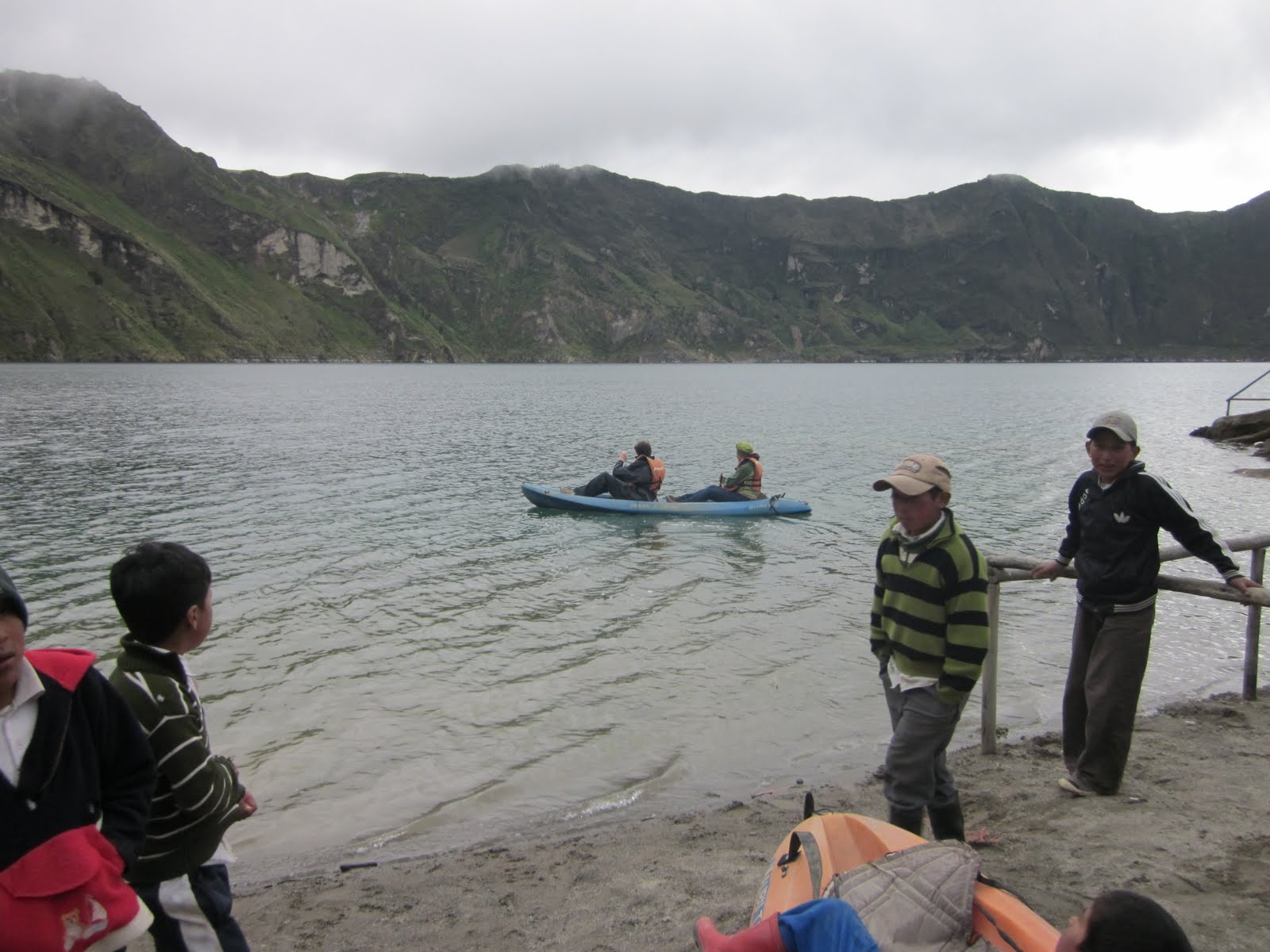
The start of my $2 kayaking adventure on the lake. A few minutes later it started hailing giant pellets. Unfortunately we were in the center of the lake at that point, left trying to protect every inch of bare skin for the next half hour with limited success.


Two indigenous women in Quito roasting guinea pigs (a dish known as "cuy"). Cuy is a traditional food in Ecuador and is often considered a delicacy. I think I'll be trying some in the Amazon in a few weeks (hmmm...).

Tuesday, March 29, 2011

Globalismo

(Globalism.)

For the last century there has been a fierce debate about the pros and cons of globalism. While we won't delve into that here, I think that the following pictures show the (sometimes humorous) presence of globalism in Ecuador.


The battle between Pizza Hut and Domino's is not limited to the States. I had Domino's with my host family the other night and my host dad absolutely hated it. We're ordering Pizza Hut next time, so we'll see if he likes that any better.


Pepsi is rarely seen here. Ecuador is the country of Coca-Cola.


Doesn't everyone remember their first pair of Nine running shoes growing up? Wait a second... Knockoff products are by no means limited to sunglasses here. Though the constitution officially forbids such activity, it is virtually never enforced.


 The ever popular Reebak sneaker.

Tuesday, March 8, 2011

¡Las Galápagos!

(The Galapagos!)

I spent the last six days in the Galapagos. I was amazed by how well the Galapagos National Park Service has done at maintaining the islands in their natural form. While the Galapagos have about one third as much land mass as the state of Hawaii, they have less than one fortieth of the population. As a result of the careful population control, the majority of the land is uninhabited and is preserved in its natural state. Below are some photos and videos that I took while there:

A wild baby sea lion ran right up to us from the water. This was pretty incredible.

One of the many species of tortoises in the Galapagos. Until recently, many of the tortoise species in the Galapagos were nearing extinction (a few are now in fact extinct). The tortoise population declined primarily due to human hunting and non-native introduced species including ants and rats. Tortoise hunting drastically decreased in 1959 when Ecuador made the Galapagos Islands a national park. Nonetheless, the presence of introduced species still poses a serious threat to the tortoise population, making it nearly impossible for young tortoises to survive in the wild. As a result, the national park is currently funding multiple programs to breed tortoises in captivity and release them into the wild once they reach five years old.

A small island of lava rock which serves as a breading ground for iguanas.

Me in front of the crater of the Sierra Negra volcano on Isabela Island. The crater is the largest in the Galapagos, measuring about 60 square kilometers. The volcano last erupted in 2005.

Apparently flamingos are native to the Galapagos. Who knew.

A blue-footed booby.

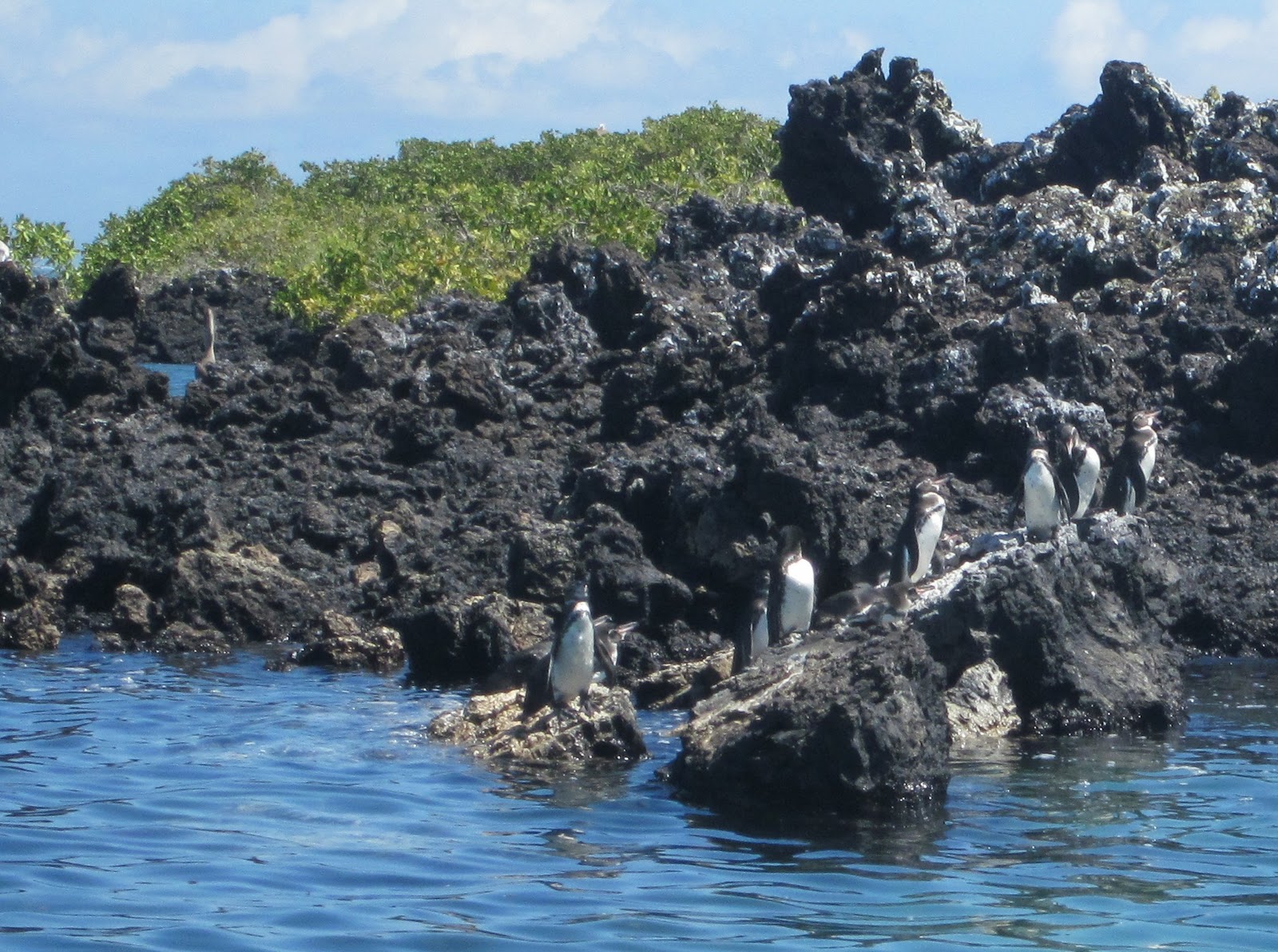
Some of the penguins that live in the Galapagos. Although located on the Equator, the Galapagos has many animals generally associated with cold climates because of the cool current coming from the south. This cool current meets a warm current coming from the north, thus creating an incredible diversity of marine life around the islands.

No Galapagos blog post would be complete without a picture of one of Darwin's finches. The species shown in this picture is one of the fifteen that inspired Darwin to write his groundbreaking work, On the Origin of Species.

Monday, February 28, 2011

El Graffiti

(You guessed it...the graffiti.)

Most buildings in Quito have at least some graffiti on them. Unlike in the United States, this graffiti does not proclaim eternal love nor does it denote gang  territories. Rather, Ecuadorians use graffiti to disseminate political messages both in favor of and against the current government. While I certainly understand why some think that the graffiti is nothing more than an eyesore, I often appreciate the opportunity to see the opinions of an otherwise silent minority on display. Below is some of the graffiti on the wall next to my house:

"Vote YES" -- This graffiti suggests that people vote in favor of the government in the referendum scheduled to be held in May. Among other things, passing this referendum would increase President Correa's power over the judiciary branch of the government, a change which critics call a step towards dictatorship.

"Che lives on. The fight continues." -- Che Guevara's image is often invoked Latin American societies. Nonetheless, violent revolution has all but disappeared from the Latin America.

"Revolution and socialism" -- Again the artists invokes revolution. Notice the other partially painted over graffiti in the background.

"[President] Correa = hunger" -- This anti-government graffiti demonstrates that certain sectors of society do not believe that Correa's socialist policies are working.

Tuesday, February 15, 2011

Río Muchacho

(A small organic farm near the coast.)

I spent this past weekend at an organic farm near the coast. The owners of the farm seek to educate the population about the dangers of monoculture (the cultivation of a single crop) and deforestation in Ecuador. For an example of the dangers of monoculture, we need look no further than the Dust Bowl in the Midwest during the 1930s. The farm practices permaculture, a more natural form of agriculture which does not deplete the soil of important nutrients and does not require the use of artificial fertilizers. If you want to learn more about the farm, check out http://www.riomuchacho.com.

An enormous strangler fig that we saw on a hike. Strangler figs grow by first wrapping themselves around, or "strangling", another tree and later dropping roots from their branches to the ground. Sort of reminded me of Avatar...

The farm served food with traditional indigenous bowls and utensils. Both the bowls and utensils were made using the shell of a local fruit.


 Me trying to milk a cow with little success.


Thursday, February 10, 2011

El café en Latinoamérica

(Coffee in Latin America.)

One might expect that Ecuadorians drink fresh coffee every morning because most of the world´s coffee comes from Latin America (Brazil is the world's largest producer and Colombia the world's third largest). While Ecuadorians do indeed drink a lot of coffee, Ecuadorians rarely make coffee from freshly ground beans. Most of the coffee in Ecuador is freeze-dried. Almost all restaurants here only serve Nestle (or some other brand of) instant coffee.

What I have with my breakfast every morning. My host mom generally gives me a cup of scalded milk in the morning and then I mix this in to make a drink known as café con leche (coffee milk).